S.B. Landscaping.
A full-lifecycle website for a Massachusetts landscaping company: digital strategy and experience design through development, local SEO infrastructure, analytics, deployment, and launch. I owned the site end to end, not just the front end.
- Live site
- Next.js
- GA4 + GTM
- Local SEO
- Role
- Website Strategy & Full-Site Delivery
- Focus
- Design, Development, SEO & Analytics
- Status
- Live
Overview
S.B. Landscaping is a family-run landscaping company working across Woburn and nearby Massachusetts communities. The work speaks for itself in person. Online, the business needed a presence it actually owned: somewhere it could establish credibility, explain its services clearly, show where it works, and turn interest into a real inquiry.
I took the website from strategy through production launch. That meant deciding what the site needed to do before deciding what it should look like, then designing the experience, building it, establishing the search and measurement foundation, configuring the domain and deployment, and validating the whole thing on the live host. The result is a website the business controls and can grow into.
The Challenge
Build trust quickly. Landscaping is local and reputation-driven. The site had to feel credible, established, and professional within the first screen.
Make services easy to understand. A homeowner should know what the company does without navigating a complicated structure to find it.
Communicate service areas. Geographic coverage had to be obvious to visitors and legible to search engines, not buried in body copy.
Create an SEO foundation. The architecture needed room to grow into service and location search demand instead of ending at a single page.
Own the platform. The business needed a production website, a domain, and measurement it controls and can keep building on.
Strategy
I designed the site around two jobs: help a homeowner understand the business in under a minute, and build enough structure underneath that search visibility can grow over time. Everything below follows from holding both at once.
- Focus the experience
- Keep the primary marketing path streamlined and easy to move through rather than front-loading dozens of search-first pages onto a small business.
- Scalable search surface
- Structure service and location content so the site can expand its local footprint over time without degrading the core experience.
- Lead with credibility
- Real project photography, concise service language, and visible contact paths do the trust work that a local service buyer is actually looking for.
- Make geography tangible
- Treat the service area as a designed part of the experience so coverage reads instantly instead of being inferred from a paragraph.
- Own the data
- Implement measurement at launch so the next round of decisions comes from visitor behavior rather than assumption.
Experience & Design
A focused first impression
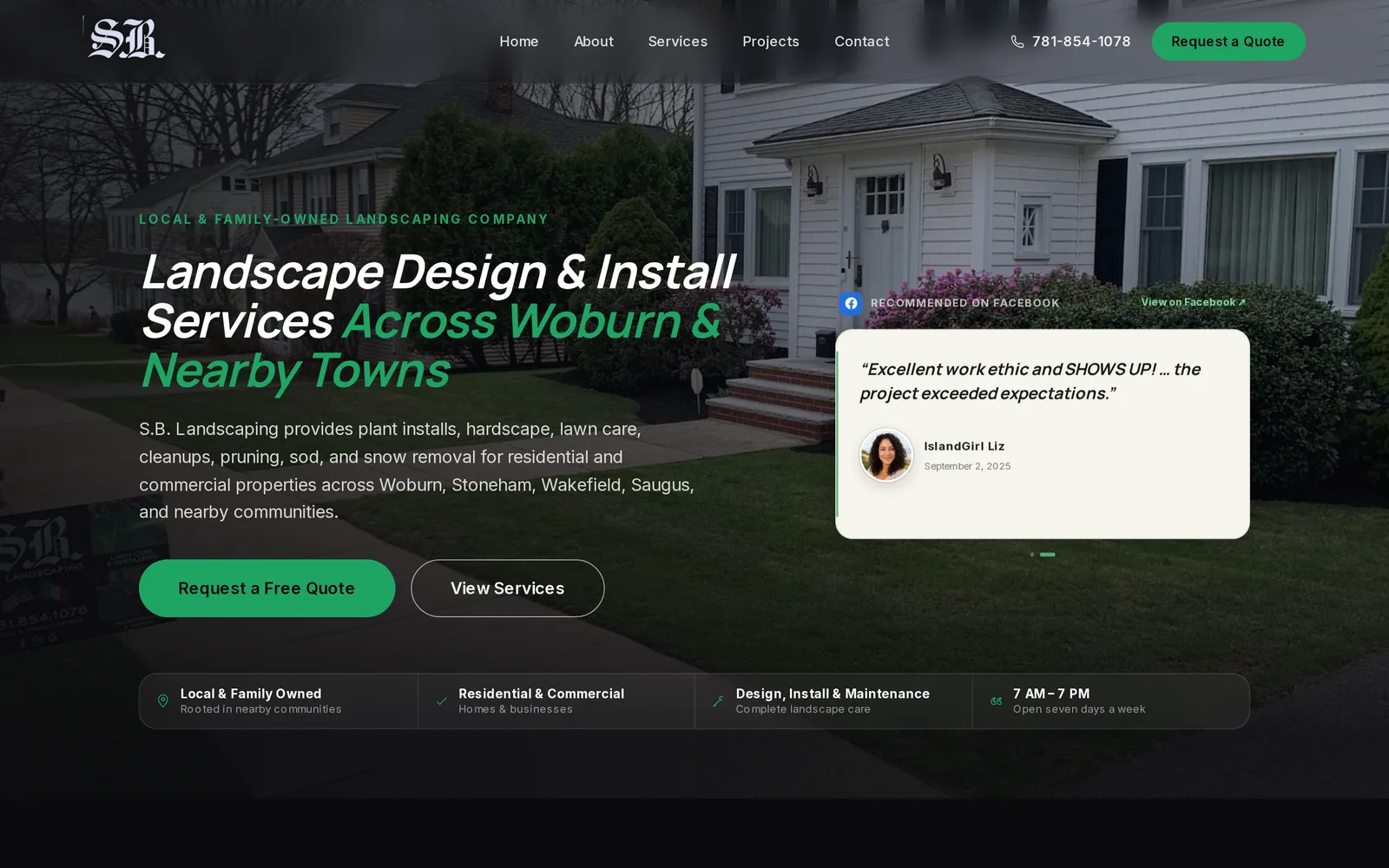
The hero carries the whole pitch: what the company does, where it does it, and how to start a conversation. Photography of real completed work sits behind it, because for a landscaping business the proof and the aesthetic are the same asset. A social review sits in the same view so credibility is not deferred to a page most visitors never reach.
Two actions compete for attention and no more: request a quote, or look at the services. Everything else in the header is a phone number, which is still how a lot of this business gets won.
Services without complexity
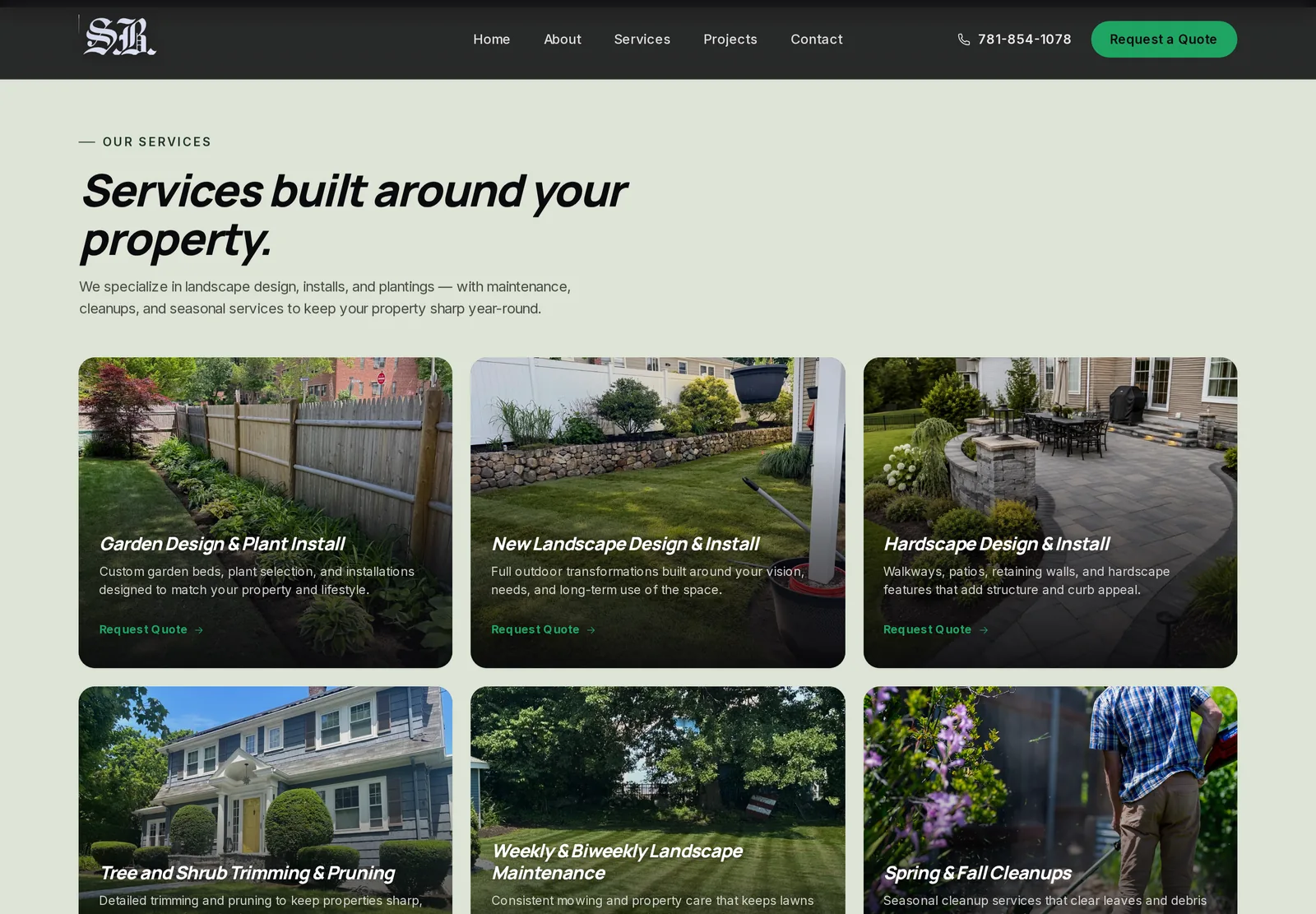
Local service sites need clarity far more than they need novelty. The services layout is built to answer four questions fast: can they do the work I need, do they work in my area, do they look legitimate, and how do I contact them.
Photography carries each card because a written description of a patio has never sold a patio. The copy stays short and specific, and every card ends in the same place.
Making the service area visible
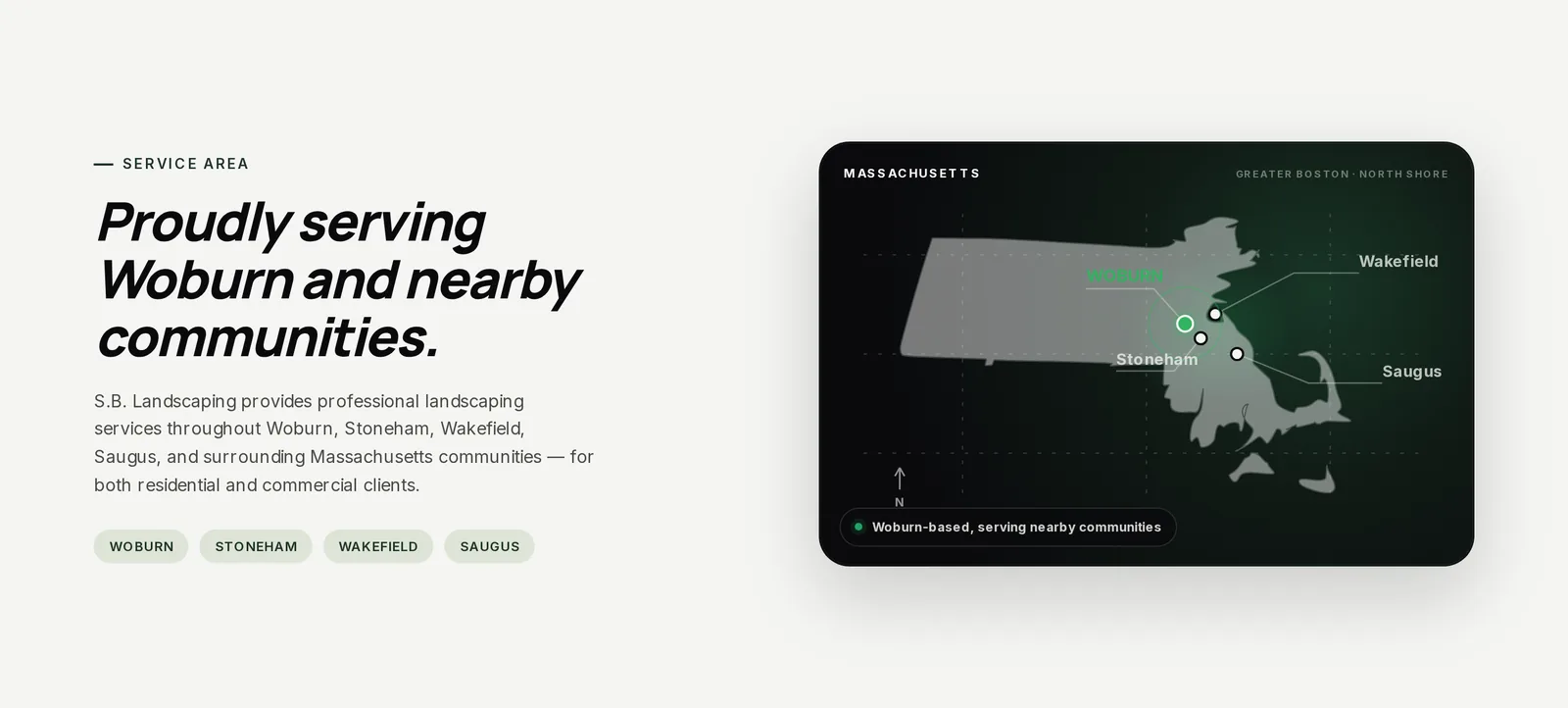
“Do you come out to my town?” is the question that decides whether a visitor keeps reading. Rather than leave it to a sentence, the service area is a designed part of the page: a map of the coverage with the named communities plotted on it and listed alongside.
The geographic presentation went through several rounds to represent communities including Woburn, Stoneham, Wakefield, and Saugus accurately rather than approximately. Getting a map roughly right is easy and reads as careless to anyone who lives there.
Built for the phone first
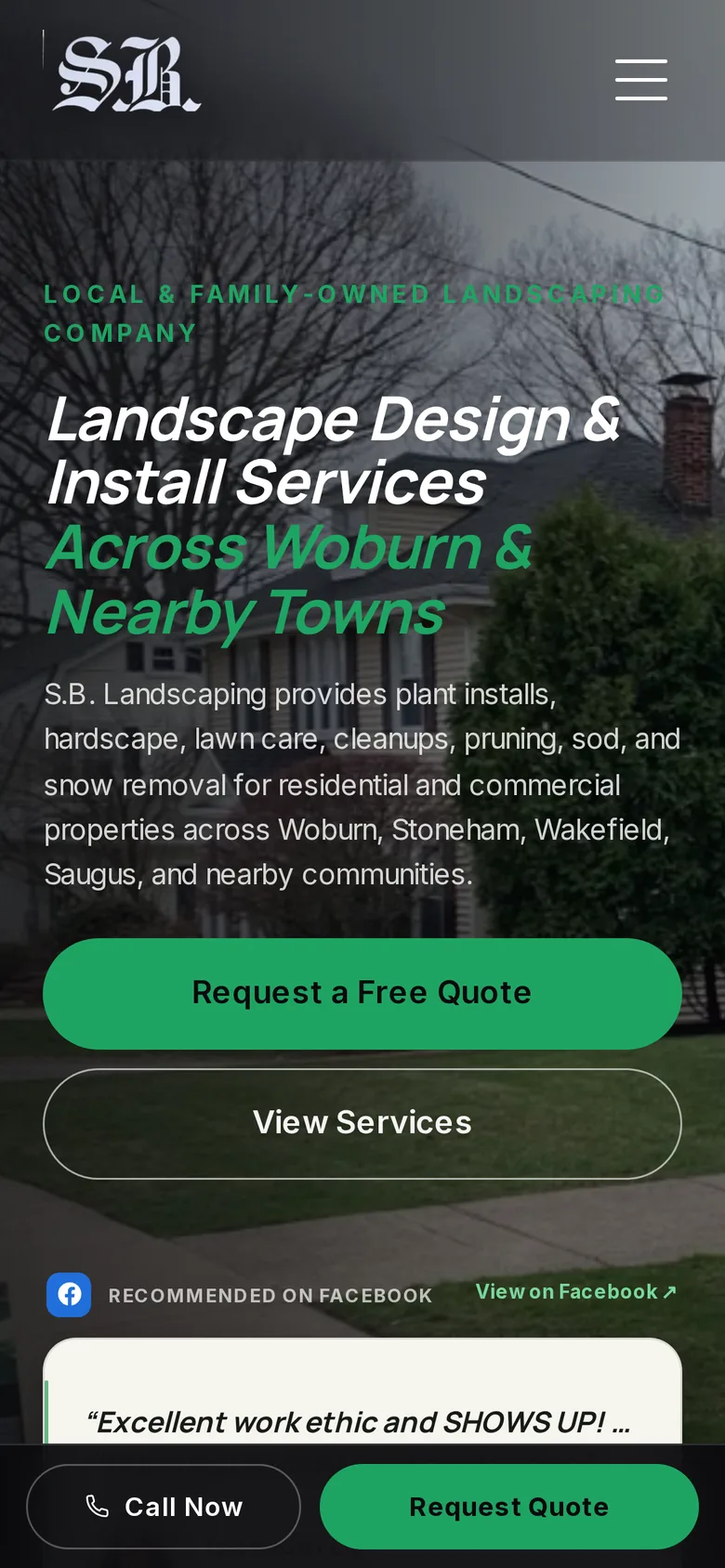
Most people find a landscaper on a phone, often standing in the yard that prompted the search. The mobile experience prioritizes readable service information, an obvious contact path, fast scanning over long reading, responsive imagery that does not cost the page its load time, and navigation that stays out of the way.
The desktop layout is the adaptation, not the origin. Type scales, image crops, and action placement were all resolved at the small size first and opened up from there.
A quote path worth completing
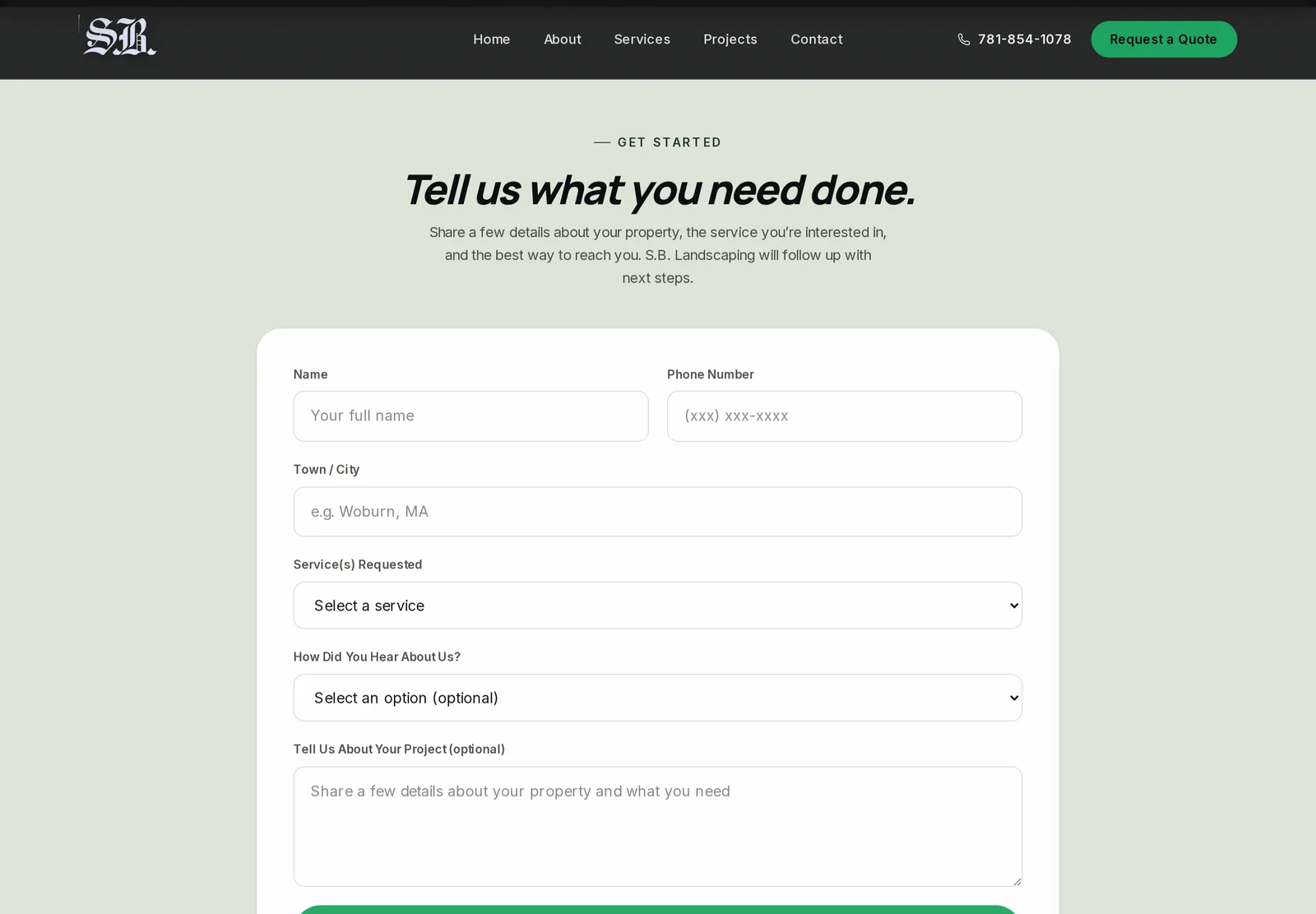
The form asks for what a crew actually needs to respond: who you are, how to reach you, where the property is, and what you want done. Project detail is optional, so a visitor who is not ready to write a paragraph still converts.
Calling remains a first-class option throughout. For a local service business, forcing every inquiry through a form is a way to lose the ones who were ready to book.
Build & Technical Implementation
The technical decisions were made against a specific constraint: a three-person crew should never have to think about their website infrastructure again.
- Next.js
- The site is built in Next.js, which keeps the service and content structure componentized and gives the project room to add pages without a rebuild of the front end.
- Static-first delivery
- Pages are delivered statically. For a content-focused local business site that means fast loads, fewer moving parts, and a hosting model that stays cheap and predictable.
- Netlify
- Production deployment runs on Netlify, with builds tied to the repository so a content or design change ships through the same path every time.
- Domain and canonical URLs
- The canonical production home is sblandscapingma.com. Canonical URLs point at that domain so the site consolidates its own authority rather than splitting it across hosts.
- Redirect handling
- The Netlify deployment subdomain permanently redirects to the production domain and preserves the path, so no deploy URL can compete with the real site in search.
- Analytics
- Google Tag Manager and GA4 are implemented so tracking existed on day one and can be extended without touching application code.
sblandscaping.netlify.app/services/patio-design
↓ 301, path preserved
sblandscapingma.com/services/patio-design
SEO & Growth Foundation
The site was not built as a brochure that happens to be online. A clean, conversion-focused experience sits on top; a scalable search architecture sits underneath it. Keeping those two layers separate is what lets the site pursue more search demand later without turning the visitor experience into a directory.
- Technical baseline
- Indexable markup, unique page metadata, canonical URLs, and an XML sitemap submitted for discovery. The unglamorous layer that decides whether anything else counts.
- Local relevance
- Service and geography stated in the places search engines actually read: title, description, headings, and the service-area experience itself.
- Service architecture
- Services are modeled as discrete, individually addressable content rather than one undifferentiated block, which is what makes expansion possible later.
- Location strategy
- The content model is built so dedicated location pages can be generated from a shared template as the business pursues more towns, instead of hand-built landing pages that drift apart.
- Internal linking
- Service, service-area, and conversion paths link into each other so both visitors and crawlers reach every part of the site from anywhere in it.
- Image discovery
- Project photography is included in the sitemap, which matters more than usual for a business whose work is visual and searched visually.
The location-page system is deliberately a foundation rather than a finished content library. The template and content model exist so towns can be added as the business is ready to serve and service them, which is a better sequence than publishing coverage the crew cannot yet deliver on.
Launch & Production QA
Launch meant confirming the website worked as a production business asset, not that the homepage rendered. The checks that mattered:
- 01
Production domain configured and pointed at the live deployment.
- 02
Canonical URLs verified on the production host, not just in local development.
- 03
Deployment-subdomain redirects confirmed to return a permanent redirect with the path intact.
- 04
Sitemap published and submitted, with indexing readiness checked before announcing the site.
- 05
Analytics verified as firing in production rather than assumed to be working.
- 06
Responsive and cross-device QA across phone, tablet, and desktop widths.
- 07
Every quote and contact path tested end to end on the live domain.
Outcome
S.B. Landscaping now has a professional web presence it owns outright: a responsive customer experience, services presented clearly, service-area coverage a homeowner can see at a glance, a lead-generation path that is measured rather than guessed at, and the technical SEO infrastructure that makes any of it findable.
More importantly, it is a foundation rather than a finished artifact. Additional service and location content can be added on top of the existing architecture, and with measurement running from launch, those decisions get to be informed ones.
Stack and Systems
- Next.js
- React
- Static delivery
- Netlify
- Google Tag Manager
- GA4
- Technical SEO
- Local SEO
- Responsive design